
The following figure shows, among other things, an inductive transducer used to generate an electrical signal. Some designs use radio frequency sensors, which have the advantage of not causing drag at lower flow rates. In other models, the shaft's rotation is transmitted to a mechanical counter by means of gears. These are vane or Woltmann flow meters.
The following figure shows, among other things, an inductive transducer used to generate an electrical signal. Some designs use radio frequency sensors, which have the advantage of not causing drag at lower flow rates. In other models, the shaft's rotation is transmitted to a mechanical counter by means of gears. These are vane or Woltmann flow meters.
These models require considerable torque, which causes start-up problems and nonlinear behavior at low flow rates. Domestic water meters, for example, often exhibit "fluid slippage" at very low flow rates, such as that caused by a dripping tap. Some Woltmann meters with the impeller mounted vertically offer certain advantages, including reduced pivot and friction effects and enhanced sensitivity, resulting in a wider measurement range. The buoyant force of the fluid also contributes to this, partially compensating for the weight of the impeller and reducing its effective mass. Figure 49 shows two such models. The first is used for liquids or gases, the second only for liquids.
These models require considerable torque, which causes start-up problems and nonlinear behavior at low flow rates. Domestic water meters, for example, often exhibit "fluid slippage" at very low flow rates, such as that caused by a dripping tap. Some Woltmann meters with the impeller mounted vertically offer certain advantages, including reduced pivot and friction effects and enhanced sensitivity, resulting in a wider measurement range. The buoyant force of the fluid also contributes to this, partially compensating for the weight of the impeller and reducing its effective mass. Figure 49 shows two such models. The first is used for liquids or gases, the second only for liquids.

Fig.: Examples of typical Woltmann mechanical counters. Left: with axial rotor. Right: with vertical rotor.
The usual manufacturing materials are austenitic steels for the body, stainless steel for the flanges and internals, and long-life materials such as tungsten carbides or prestressed steels for the pivots. For high-pressure applications, high-tension flanges (PN > 1,500 bar/21,750 psi) are available. In addition, both the body and the other components can be manufactured from durable plastic for applications in the chemical industry. However, it is clear that each material has a maximum operating temperature and pressure. For this reason, it is advisable to follow the manufacturer's recommendations in all cases.
Special models have been developed for unusual applications. One special model for measuring the flow rates of chemicals completely eliminates pivots and uses the thrust generated by the blades to rotate the rotor freely with the fluid inside the housing. In this model, two rotors are located at either end of a vertical shaft. The combined thrust and drag forces on the two blades at either end keep the assembly floating freely inside the housing. Induction sensors measure the rotational speed. These models can be made of chemically resistant materials such as PVDF or PFA and allow for measuring the flow rate of "dry" chemicals such as acetone or SF6.6.

Fig.: Model of a turbine-type flow meter for measuring very low flow rates. a = Flow meter body, b = Interchangeable adapter (for extending the measurement range), c = Measurement opening, d = Pivot, e = Turbine rotor, f = Induction sensor
For very low flow rate applications, the incoming fluid is passed through a narrow opening to increase its velocity (Fig. below). As it exits the opening, the fluid jet impacts a small rotor. Magnetic (or sometimes optical) sensors record its movement. These models use lightweight rotors mounted on fine stone pivots that offer minimal frictional resistance. The figure below shows a model with interchangeable inlet opening adapters. The adapters can be changed, allowing different flow rate measurement ranges to be covered with the same meter. However, the linearity and repeatability of these flow meters are not as good as those of conventional turbine meters.
Some highly specialized models have also been developed for hygienic applications. Measuring the flow rates of milk, wine, or fruit juice requires the use of special pivots, coated heads, and hygienically approved materials. Indeed, some models are certified.
3A. These models can be periodically sprayed with cleaning and sterilizing fluids. However, these models can present problems when purging gases or vapors because the high velocities reached can damage the rotor or pivot. Insert turbine flow meters have been widely used since the 1980s for monitoring water flows in industrial plants. As shown in the following figure, these flow meters are, in fact, small "turbines at the end of a rod." These devices exhibit high local sensitivity and repeatability. Some models are propeller-type, while others conceal the small turbine inside a housing. Overall experience with these devices is reasonably good in flow monitoring applications in large-diameter main water pipes.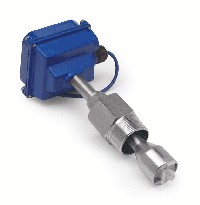

Fig.: Insert turbine counter.
Help us grow
Finally, if you are determined to learn Industrial Automation and advance your professional career, you may be interested in our Premium courses:
– Click to see all our courses at MyAutomationClass.com
- Course: «"Become a PLC expert in 60 days, from basic to pro"»
- Course: «"PID Controllers Master Class – 100% practical"»
- Course: «"How to create SCADA/HMI projects from scratch with InTouch"»
- Course: «"PID Tuning Ultimate: The Definitive Course for Tuning"»
- Course: «"Practical Process Modeling: Definitive Steps to Becoming an Expert"»
- Program: «"The Ultimate Process Control Formula" (All-inclusive: PID Control, Tuning, and Modeling)
- Course: How to Learn Industrial Instrumentation, Easily (Complete)
If you have any questions, contact us via Facebook Messenger
Until next time. COMMENT AND SHARE! I'll be happy to answer your questions.


 Spanish
 English
Yes, engineer, I have a question. I'm an electrical technician, and at the company where I work, this is the first time we're implementing this turbine-type flow meter. I'd like you to guide me on how to use it.